Eight individual features. Working as one system.
Not one technology, and not a simple app. Eight individual features in one unique platform, built and hardened over more than five years, working together under our in-house Emergency Response Centre, from the first alert to the all clear.
ERC
Our emergency response team has looked after incidents since 2013, and the ERC was redeveloped specifically to enable our lockdown response. Manned around the clock by ex military Controllers, it brings real-time data, CCTV and live communication into one operational view, working alongside your Crisis Team and the emergency services.
Crisis Calls
The first seconds are critical. Any member of staff can report an incident to the ERC on your dedicated number. Our Controllers determine the level of response required and call in your appropriate team, senior leadership or security, and ultimately the emergency services. A shorter call chain, with no single point of failure at your reception desk.
SmartAlarm
On your say so, our Controllers put your premises into lockdown using SmartAlarm, getting people safe in the first critical minutes. It broadcasts visually and audibly across the PCs, laptops, Macs, Android screens and Chromebooks you already own.
Headcount
A poster in every room carries six simple steps and a QR code. One member of staff scans it on their own phone, with nothing to download, answers a few short questions about who is in the room, anyone hurt and anyone who cannot move, and submits. That page then stays open as their live link to our Controllers, which is where updates come back to them. Room by room, those answers build a real picture of the whole site, so help goes to the right door rather than the whole building.
SitRep
Verified updates flow both ways between on-site staff and ERC Controllers, triaged and cross-checked in real time, so guidance fits what is really happening, room by room.
CCTV
On activation, Controllers use your existing cameras to identify threats, trace movements and relay verified intelligence to your Crisis Team and the police. It is incident-triggered access, never routine surveillance.
JobTrac+
Built from lone-worker technology with a heritage in NHS environments, where it has been proven since 2016, JobTrac+ gives round-the-clock cover for lone and out-of-hours workers, fully integrated for estates, security and assessment teams.
Debrief
Recordings, messages and voice logs from the incident are available as a one-click download, with a full, timestamped report on request for all relevant parties.
 Eight features. One response centre.
Each one is proven in its own right. Built to work together, in real time, under a single response centre.
Nothing has to be joined up by your team in the moment. That is the whole point: on the worst day, your people are not integrating systems, they are being looked after by one.
A plan on paper is not the same as readiness.
Picture the first person to see an intruder in your car park. How do they warn everyone else, all at once, without leaving the room? For most premises the honest answer is to tell reception, who tells a manager, who decides whether to alert the senior team, who decide whether to call 999. Four handovers, each costing seconds, and the whole chain resting on individuals. If one of them is away from their desk, or has been caught up in the attack itself, the chain breaks before it begins. It reads the same in a college, a council building, a hospital corridor or a hotel at three in the morning:
"Staff are not trained to run a crisis. Reception desks are not control rooms. Management teams are not emergency command centres. Yet in-house approaches knowingly place them in that position, at the point where failure carries the highest consequences."
One call does it all.
The moment an alarm is raised, our 24/7 Emergency Response Centre opens a secure command room, uniting your leadership, our Controllers and the emergency services. You are never left to decide alone.
What happens today
Four handovers before anyone who can act on it knows.
An incident travels through your building before it reaches anyone who can act on it. Every handover costs time, and every handover loses something.
The caller stays on the line as a live source of information, while everything else starts at once.
From the first call, all at once
Your senior team, on a secure call
Brought together on their mobile phones, with security and the emergency services joined in as the incident needs them.
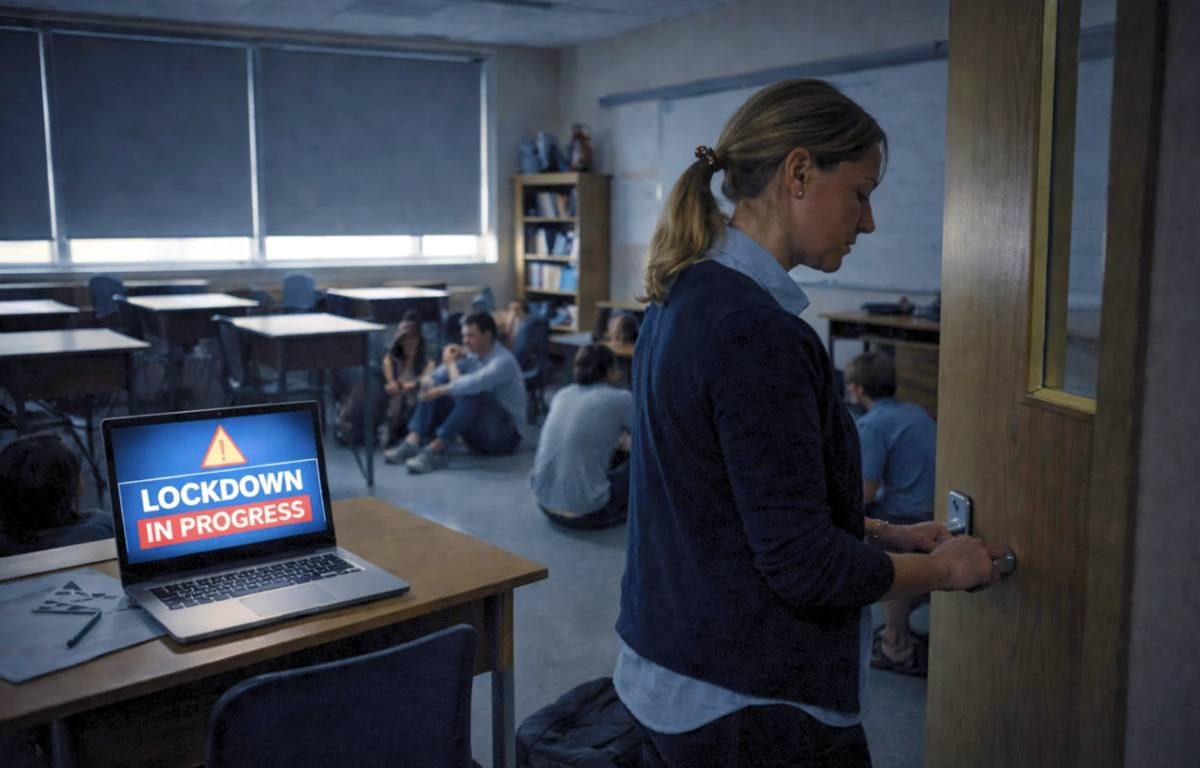
The lockdown message, on your screens and handsets
Pushed through your own IT, replacing whatever was on them, dark background and light text so the room does not brighten.
A live picture, room by room
Staff scan a QR code to report who is with them, who is hurt and who cannot move, building a situation report for your team and ours as it happens.
Instructions going back out
Updates reach those rooms throughout, normally in your senior team's own words.
Not one thing after another. All of it, from the first call.